
Summitting Ever Higher
Two men converged in a yellow room, and sorry I could not tune it out

There is a summit happening in Beijing. I was just in Beijing myself, visiting the Beijing Auto Show and participating in a track two dialogue with American and Chinese “economists.”1 I’ll share more about what I learned in my time there, and maybe some pictures, next week.
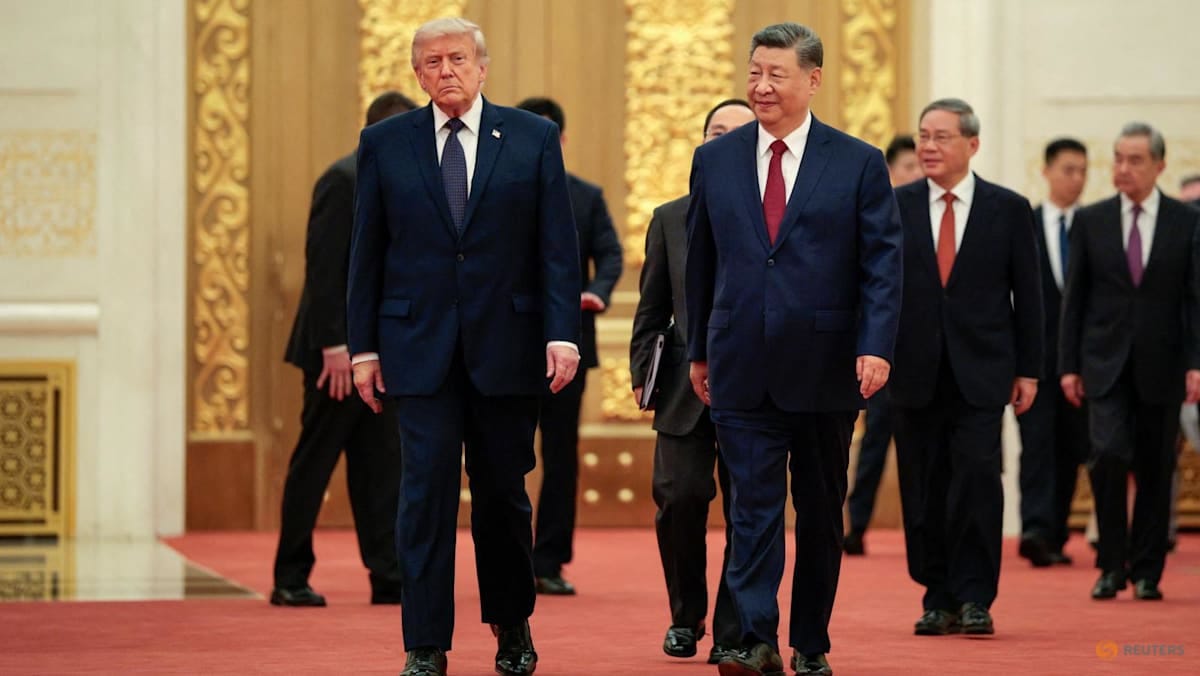
With apologies to Mr. Frost, two men converged in a yellow room, and sorry I could not tune it out.
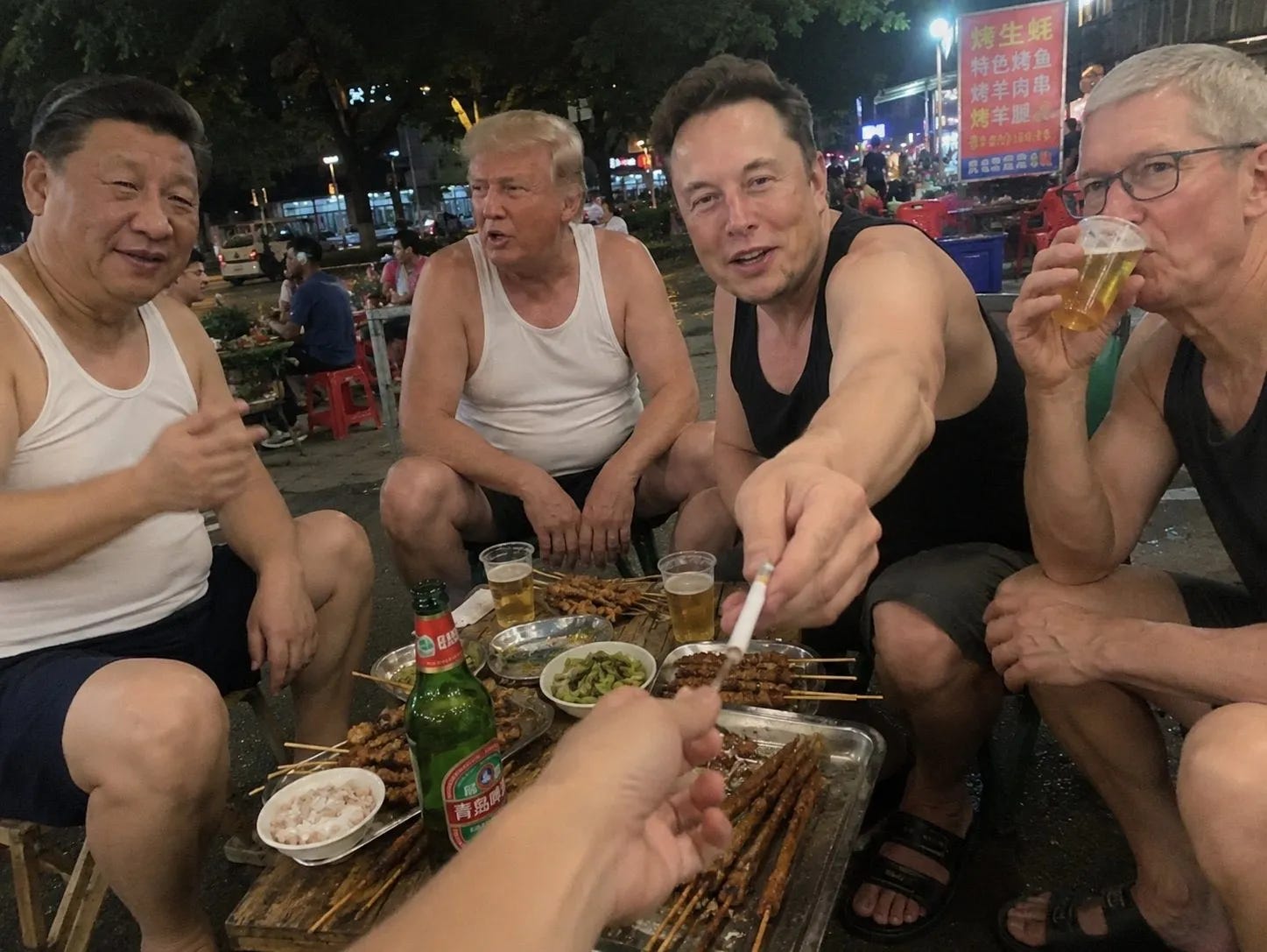
Now, if the image below were reality — and to be very clear it is not (a still from an AI video that was going around a couple days ago), perhaps there’d be more to talk about:
It is quite possible that many consequential things will happen in the summit. There’s lots of commentary about what might happen and the parsing of word choices. This makes sense because states are ultimately constituted of people in roles who make decisions with words. The difference between “not supporting” something and “opposing” it matters. I’ve contributed to this discourse myself (look out for a new episode of the Shift Key podcast tomorrow) and will have more thoughts afterwards. But the conversations between Xi and Trump and their retinues will largely ignore the core interests of this newsletter: China’s green tech revolution and the evolution of our economies facing the climate crisis. I recently wrote an essay I’m quite proud of comparing America and Chinese economies for the Break-Down: Capacity Returns [gift link]. My last post was about it.
From one vantage point, an interesting possible outcome would be about an openness or encouragement of Chinese investment in the US, particularly in the EV sector where Chinese leadership is globally acknowledged (though see below). The politics of such investments are dicey on all sides but also offer genuine opportunities to provide benefits to actors on both sides of the Pacific. American consumers might get access to cheaper, cleaner, better cars. American workers might have their employers pushed to actually compete in these growing sectors rather than coasting in an ICE island protected by “connected cars” rules and tariff walls. Chinese firms might find a slice of the very profitable American auto sector to help stabilize their often sketchy finances. I’m writing about this now but am waiting for the summit to finish to share any deeper thoughts.
The optics of summits give the illusion that these individuals represent the societies that they ostensibly rule over. And of course there is a bit of truth to that illusion, but both Xi and Trump are wobbly leaders dealing with frustrated publics. The US discussions lean into this — Trump’s disastrous Gulf War 3 took his already negative approval ratings straight into the toilet. Xi, by contrast, is being portrayed as if things are great in the middle kingdom, and while there are macro- and micro-economic bright spots, unemployment remains high and the real estate downturn refuses to bottom out.
The Trump administration remains committed to stubbing America’s toes.
The Trump administration is not backing down from its discriminatory policies for approving wind and solar projects. Interior Secretary Doug Burgum testified to Congress on Wednesday that his agency would appeal a recent district court ruling blocking it from enforcing these policies.
To translate the multi-layered legal negatives above — lots of wind and solar projects have been blocked by discriminatory policies from the Administration. Those decisions have been thrown out by a number of different judicial rulings at various points in time. Burgum is insisting that they will appeal those rulings and hence keep the bans in place. Solar, wind, and batteries are the heart of the clean energy transition — the green tech revolution — and belittling them does not change their economics. Keeping America from taking advantage of their efficiency only makes us poorer and our air dirtier (and fills the pockets of their friends in fossil fuels by taking money out of ours).
I’ve already had my say about the dubious Climate Realism Initiative from CFR but recently came upon their Nov. 2025 report Ranking National Contributions to Global Energy Innovation, which encapsulates so much of what is wrong in the think tank / climate innovation space that friends described it as “peak western neolib slop” “copefrogging” and more that aren’t advisable in this family-friendly newsletter.
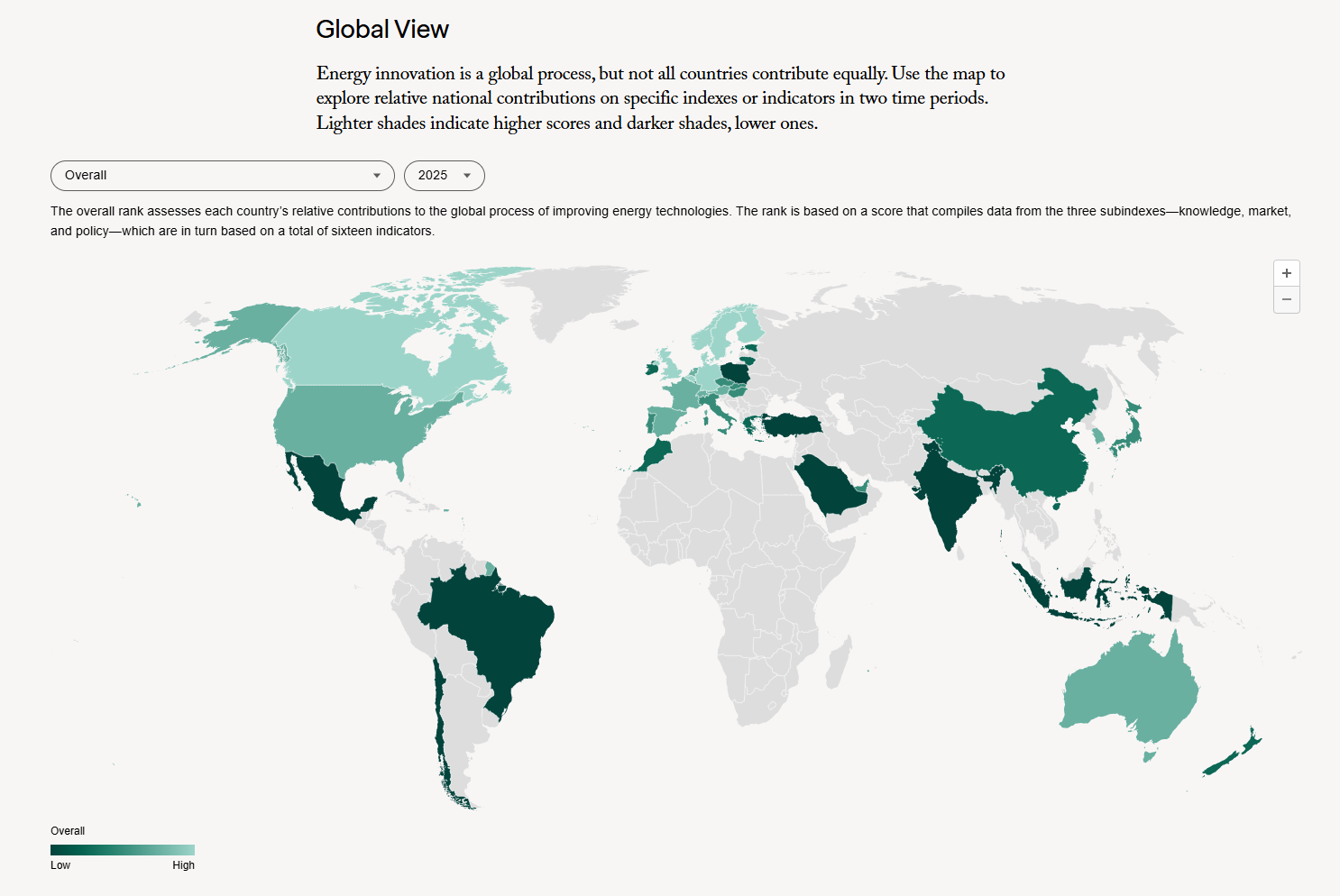
The idea that Sweden, Denmark, Finland, and Norway are leading the world in energy innovation is — with apologies to my Scandinavian friends for their real efforts to make things better — hogwash. The technical flaw in methodology here is that most contributions are normalized by a country’s economic size. But emissions are just in the atmosphere. The climate crisis doesn’t slow down because the emissions intensity of GDP goes down. Real bulk changes in the material reality of how we live are lives is what this requires, and big countries cause more problems though also tend to be where solutions come from. That’s why we care when their leader’s meet in yellow rooms. The deeper pathology of this report and line of thinking is that innovation is the key to responding to climate change. There was a time, perhaps twenty years ago, when this made a lot of sense. But for the past decade, the technologies that will do the majority of the heavy lifting in reducing emissions have been apparent: solar, wind, batteries, and EVs. Deploying those technologies and further improving their economics is the main story.
And one way in which improved economics arises is process innovation. Building a million solar panels teaches people and firms a lot about how to do it better. Reports like this one need to go away or innovate into a better model of the political economy of the climate crisis.
Finally, and tying things back to Capacity Returns, building factories matters. And despite a lot of great ideas emerging from the US, we consistently lag in making them real and significant. In China, I repeatedly heard that the US remains the best in the world at going from zero to one but China is still where 1 becomes many.
Leapfrogging is not the solution. If you do not have an ecosystem that supports the construction of industrial capacity, people with ideas will choose to build factories in places that value factories.
Here’s yet another version of that story.
US battery startup builds factory in China after nixing Kentucky plant
With $300M in new funds, EnerVenue says China is in fact the best spot to scale its NASA-inspired tech
People come together, and they go. The problems facing us are rising, as are the number and breadth of solutions. We live our days on this planet. May there be many good ones ahead of us.
Many of the Americans were not formally trained economists, for better or worse. (Not for worse.)