
Where to now? What next?
Promises for the year to come

Happy new year! It’s mostly terrible here in DC, but that should not stop us from thinking about tomorrow. There is good news out there, if you can get past the obviously significant orange man’s efforts to smush the world’s most powerful country into his personal fiefdom and imperial plaything. To be clear, in this newsletter we hold these truths to be self-evident: the United States should not have a gestapo, and they should not be shooting people in the face. The state should not be kidnapping foreign leaders. The state should not threaten to annex icebergs and the communities that live around their edges.
The Ezra Klein Show episode with M. Gessen was beyond bleak. It also accurately reflects where we are an where Trump and his cronies would like to take the country and the planet. The major issue that I want to focus on is spectacle and attention, and political responses to it. MAGA explicitly points to the past when looking at the future, and Gessen literally has a book titled The Future Is History about Putin’s Russia. Their conversation covered the ground as you might expect it to, though I was a bit surprised by Klein’s idea that Trump is somehow hypermodern — in that he operates always and everywhere as an avatar, a character devoid of normal humanity, a creature of the screen, of the feed. And that it is becoming what others are doing as well, Kristi Noem in front of the prisoners at CECOT, for instance. Gessen took this observation in a good direction that we’ve covered here previously:
I think that’s a great observation. I do want to temper it a little bit because I think there’s a craziness to what we’re living through that has to do with how we got here — which is that politics should have spectacle. Politics should have a public dimension.
In the preceding, more “normal” administrations, we didn’t have that. The Biden administration was a bizarrely closed black box — bizarre for any administration but particularly for a Democratic administration. It was an administration that utterly failed to tell any kind of story.
I’m sure a lot of it had to do with Biden’s deterioration and his inability to really be in public. But really, it was like a closed management company that was just trying to get stuff done without being distracted by doing public politics.
This is what I was trying to get at a year ago in “Bidenism’s Frustrating Failures.”
In the end, I think my frustration with Bidenism was its reluctance to engage in debate and discussion. To listen broadly and deliberate publicly. Biden prided himself on getting things done, almost certainly. Leaks are bad; coherence is good. But what if what democracy needs gossip, not gossip really but opportunities for debate and detailed discussions and arguments about why something is happening rather than some other alternative. What if you need a few low-level staffers to talk with reporters about internal debates so that there’s something to write about other than just today’s press release? To argue for or against, to talk through the tradeoffs of things, rather than defer to the political expertise of the Biden team, which operated as if some kind of democratic centralism was at play. As if things were completely settled internally, that the Senate is the only thing that mattered and the public (and allies and companies and so on) could be ignored other than to be asked to vote at the appropriate time and maybe to clap from time to time.
Attentional politics matters, and Bidenism completely failed at it. But there is another layer here that I worry deeply about, and is something that I know I’m not alone in worrying about: that objective material reality does not matter, only the subjective experience of things matters. Gessen again:
For example, we talk about the scenario where Venezuela goes all wrong, and there are boots on the ground, and American soldiers are dying, and nothing is working as intended, and the oil wells are not sprouting fountains of gold that fund this whole operation and enrich the United States. When none of that is happening, does that have consequences for the midterm elections? That would be democratic metrics.
I very much doubt that it will have consequences for a couple of reasons. One is what has happened to the media universe. The pictures that MAGA voters, for lack of a better term, see, and the pictures that you and I see are completely different. Will people who need to see what’s happening in Venezuela have any idea about what’s happening there? Will people who don’t read The New York Times have any idea what’s happening there? I doubt it.
Obviously for a set of true believers this is the case, and about Venezuela, a place that exists solely through their screens for many of them and a place they’ve never been (I’ve never been) this is easy to believe. But what about jobs and prices? Things that people do experience? I think the election results that we’ve seen and the polling indicates that people are frustrated with what has not happened and blame Trump for his failures to deliver. I worry though still that the feed dominates all.
I tried these posts, but nothing went viral.
If material reality doesn’t matter compared to the feed, then perhaps big brains aren’t exactly the great evolutionary investment we led ourselves to believe.
If material reality doesn’t matter compared to the feed, then perhaps the Fermi paradox isn’t so paradoxical.
Gessen argued that there is perhaps an effort to switch from an “authoritarian bargain” where your life will improve just shut up about politics (similar to what I called the “technocratic mode” in China, though obviously neither Putin nor Trump evince technocracy) to a “totalitarian bargain” where your life might suck but your part of capital-G Greatness of imperial adventures and gold ballrooms. Joy through dominance and implied status, circuses with no promise of cheap bread.
Jay Kang gets at this today as well.
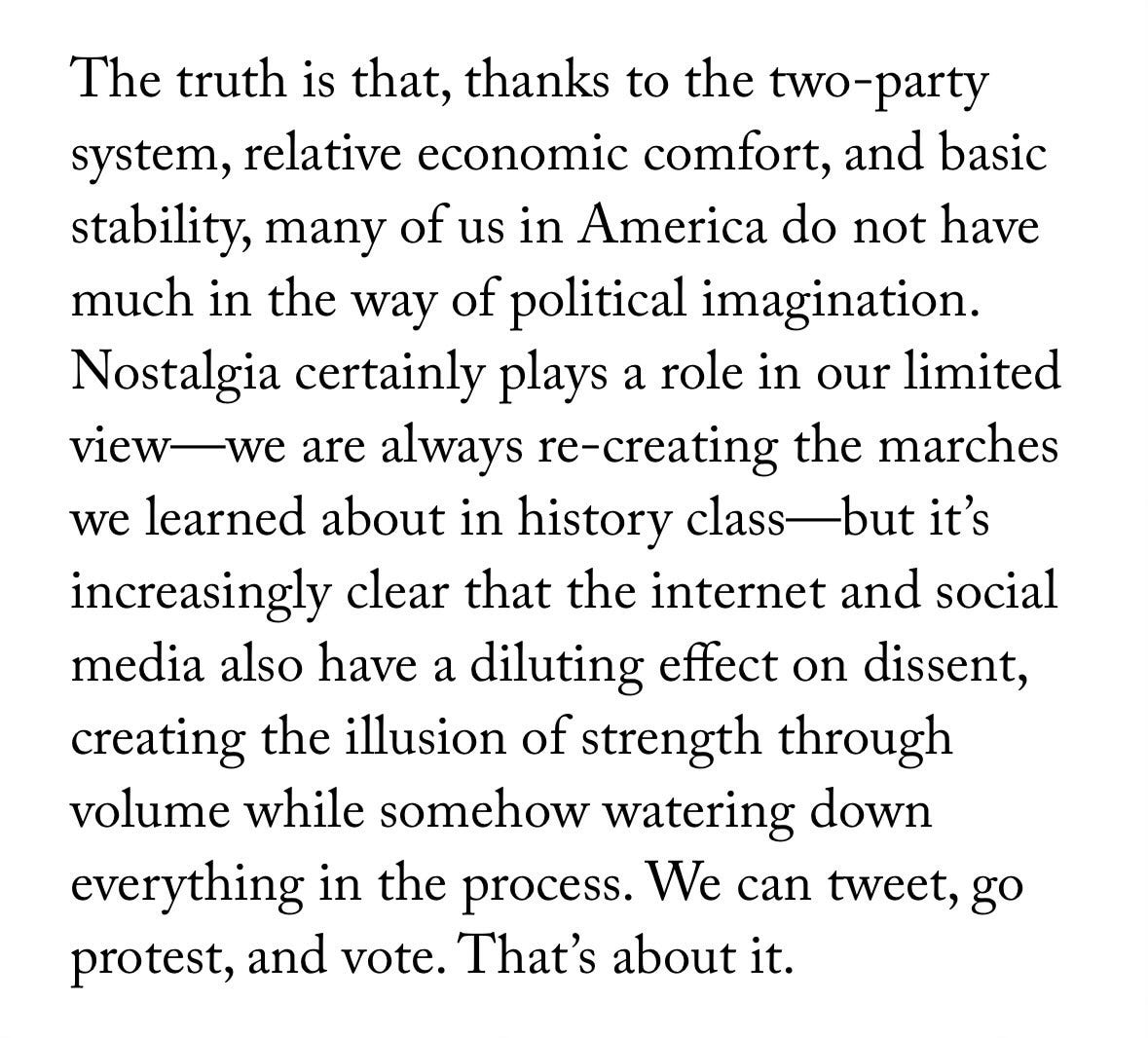
And so the need for more political imagination is something that many of us are circling around these days. Which is one reason why the Schumer / Jeffries tactic of not speaking or getting in the way of Trump torching his own popularity feels so frustrating. Dependence on thermostatic public opinion might win Democrats the 2026 elections, but it will never expand the political imagination of the American people. It also has the unfortunate problem of being adjacent to a Biden administration that was attentionally ignorant to the point of silence. And so Democratic politicians, whether they are in office or out of office, agree that the best way to be is to be quiet. This will not work.
More imagining is needed, individually and communally. Not just retvrn but building something new. Reconstruction, but by whom, in what order, and for what purpose requires deliberation and planning.
The desecration of these United States is not the only thing happening on this planet, and it is not the only force shaping the future. For instance, last year saw both India and China decrease their coal power generation, for the first time in over half a century.
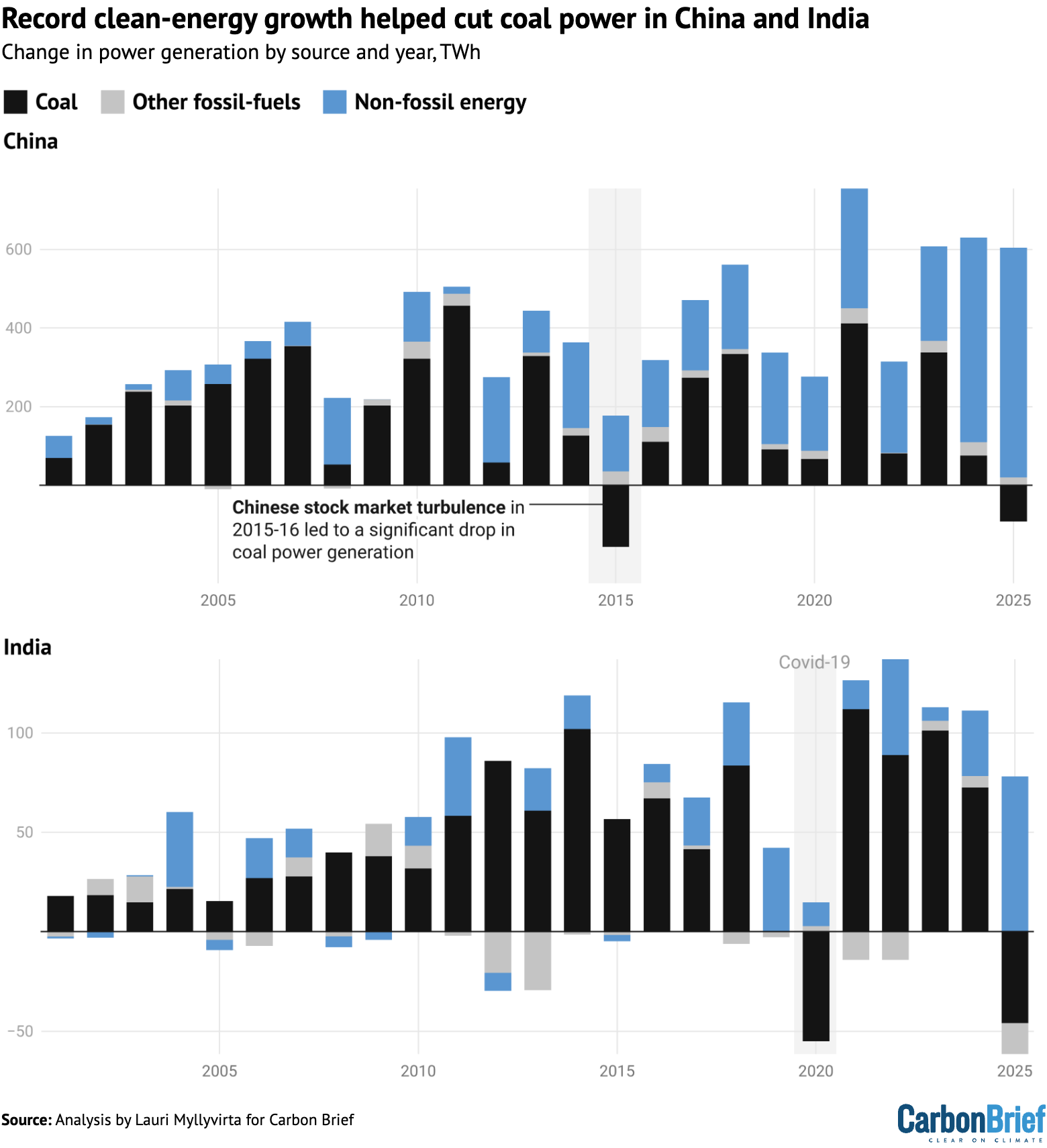
These are the places that scholars have worried about most when thinking about the climate crisis. They account for well over 90% of the world’s emissions increases over the past decade. If they are turning the corner towards a green tech revolution, then there is more than just a little ray of hope shining our path towards a better future.
As part of that effort, I’m going to be doing my best this year to share some of my thinking about how we can get on that path, the challenges and choices we face in doing so, and the opportunities that it can provide for us. That’s the plan for this here newsletter into the year. As a key part of that effort, at least at the start, I’m going to be doing some reading and reviewing.
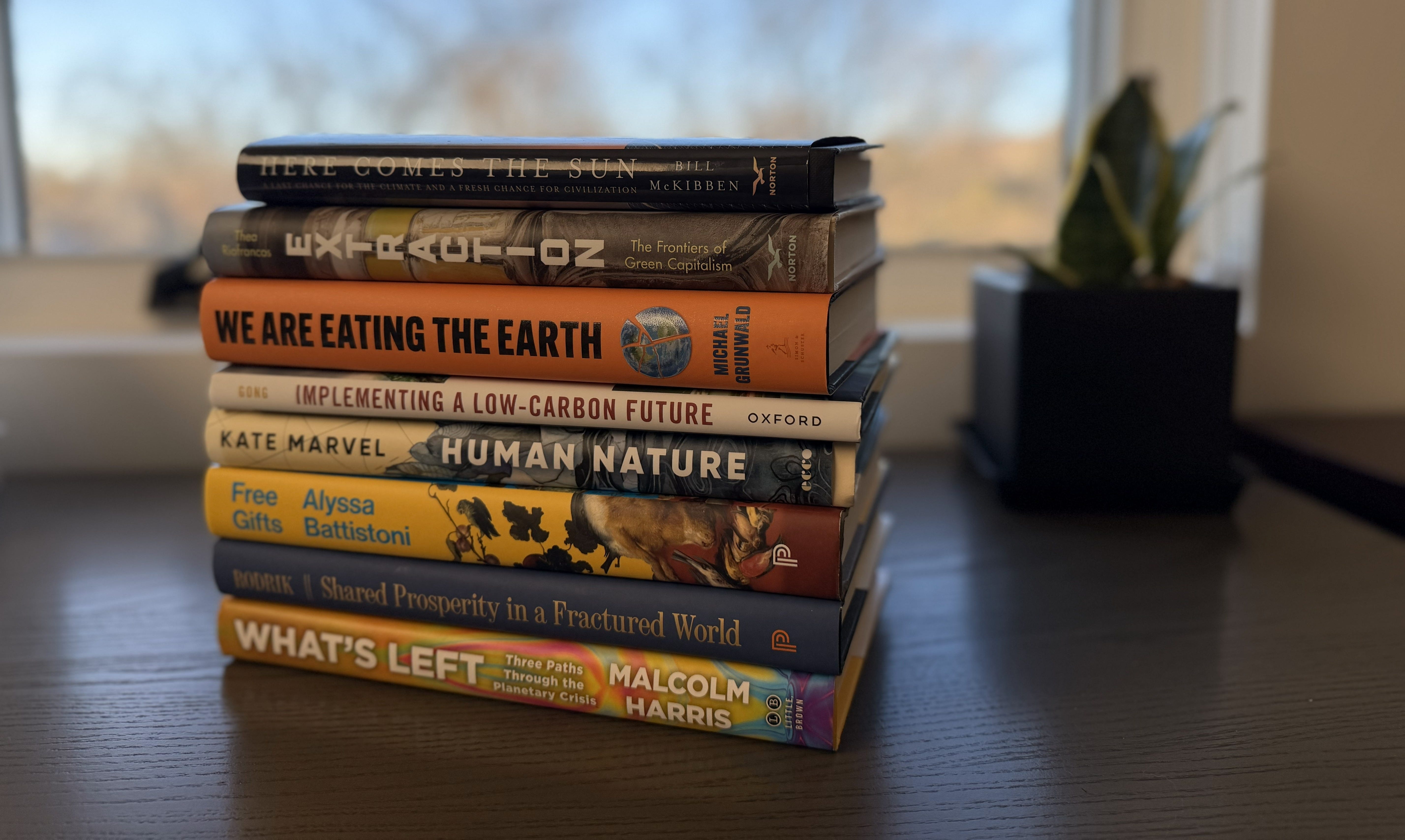
I’m still working on formats. These books obviously speak to each other, and I have my own reactions to each of them independently and jointly. I’ll likely write up more informal reviews of the books individually here and then stitch together things once I’m through this stack.
Are there other books I’m missing? What else should I be reading? As always, climate-related fiction recommendations are particularly welcome. I enjoyed Ministry for the Future and Deluge and The Water Knife and Weather, but would like to read more.
As I suggested in my last missive, I have a few other projects of my own that aren’t out yet but will be coming shortly. A couple of podcast episodes have been recorded and one piece for a new outlet for me is coming very soon. And, inshallah, something else sometime soon. But for now just remember that as we fight in the present to remember planning for the future and building it everyday.
Climate fiction rec: Mobility by Lydia Kiesling!